The liquidity that isn't there

On the morning of 15 January 2015 the Swiss National Bank announced, without warning, that it would stop holding the franc at 1.20 to the euro. The floor had stood for three years, defended in speeches as recently as that week. Within twenty minutes the euro lost roughly a third of its value against the franc. The detail everyone remembers from that day is the price. The detail traders remember is the screen: for several minutes, in one of the most traded instruments on earth, there were no bids at all. Not thin ones. None. A market that turns over trillions had, briefly, no price.
An order book photographs well. Rows of bids stacked like brickwork, totals growing as you scroll down, the whole thing shaped like infrastructure. It invites you to lean on it. Every row, though, is a quote from a professional whose entire craft is knowing when to step away. A market maker earns a sliver on each trade for standing in the flow and loses a fortune by standing in front of the wrong trade, so the firm's software watches for the wrong trade with more attention than most people aim at anything in their lives. When the headline lands, the quotes are gone before you finish reading it.
Crypto runs the same physics with the safety covers removed. On 12 March 2020, as the pandemic hit every market at once, bitcoin roughly halved in a day. Leveraged longs were liquidated into a thinning book, each forced sale knocking the price into the next tier of forced sales, and at the worst of it the largest derivatives venue, BitMEX, went offline, citing a hardware failure, and the cascade paused, which tells you what was driving it. People who held spot with no leverage woke up poorer but fine. People who trusted the book to absorb their exit discovered what the book is: a queue that disbands when the queue is needed.
The order book is a photograph of promises. The market is what happens when you try to collect them.
There are two further tricks of the light worth knowing. The first is double counting. The same market-making firms quote on a dozen venues from one pool of inventory, so adding up the depth you can see across exchanges overstates what could actually be sold into it; touch one book hard and the others reprice instantly. The second is theatre. Some displayed size exists to be seen rather than filled, placed to suggest support and cancelled as price approaches. Regulators prosecute this in futures markets under the name spoofing. In less supervised corners it does not need a name.
Even the instruments engineered to never move can teach the lesson. In March 2023 the second-largest dollar stablecoin, USDC, disclosed that part of its reserves sat in Silicon Valley Bank just as that bank failed. Redemptions at one dollar were paused for the weekend; the only exit was the open market, and the open market did what it does when everyone faces the same door. The coin traded below ninety cents on Saturday, from holders paying a twelve percent fee to whoever would take the other side of their fear. By Monday the promise was restored, the peg snapped back, and the sellers had converted a weekend of worry into a permanent loss. The reserves were nearly fine all along. The liquidity was the crisis.
What would an honest measure look like? Something closer to this: how much can be sold, within what window, at what cost, on the day the reason for selling is on every front page. Calm-day slippage answers a different and mostly useless question. For scale, the desk measured a calm day from live order-book streams as this issue closed: filling a million dollars of bitcoin against the displayed book cost between one and two basis points, five million under four; the same clips in SOL cost roughly nine and thirty-six. Book-implied numbers, on a quiet Sunday, printed mainly so that a future issue can print the same table from a loud one. Liquidity is correlated with everything else going wrong, because the moment your position is falling is the moment the identical positions of strangers are falling, and the exit everyone priced in is one door wide.
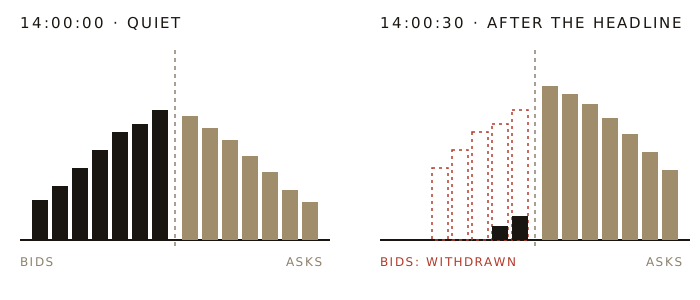
The discipline that follows is unglamorous. Size positions against stressed depth, and treat displayed depth as a courtesy. Prefer instruments whose worst half hour you have seen, or can at least imagine priced. Ask of any position the only liquidity question that matters, which the screen has never answered: what will it cost to trade a lot, in the minute when everyone else must trade too. The screen tells you what it costs to trade a little, right now. The gap between those two numbers is where drowned portfolios are buried.