The index ate the market

When John Bogle launched the first index mutual fund in 1976, the industry called it Bogle's folly and un-American, on the theory that no red-blooded investor would settle for average on purpose. The fund raised a fraction of its target and spent years as a curiosity. Half a century later, settling for average on purpose has conquered the world. Passive funds hold more of the American stock market than active managers do, index providers rank among the most powerful unelected institutions in finance, and the folly compounds quietly in half the retirement accounts on earth. It stands among the best deals ever offered to the ordinary saver, and this essay comes to praise it before burying a warning in it.
The praise first, because it is deserved. The average active fund lags the index after fees, in most years and over most horizons, a finding replicated so often it has stopped being interesting. The reasons are structural rather than moral: active managers as a group hold the market, so their average return is the market's, minus the costs of the effort. Indexing simply declines to pay the costs. For a schoolteacher saving for retirement, the humble index fund has been worth more than a century of stock-picking advice. None of what follows contradicts this.
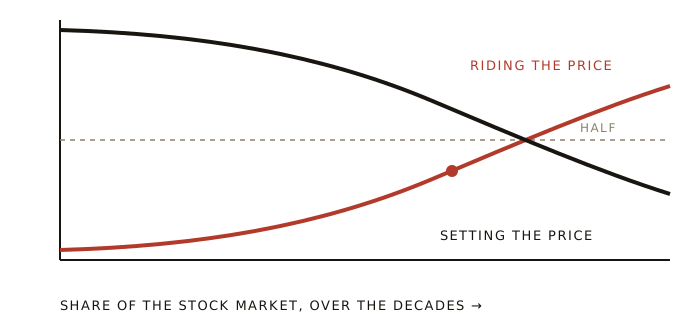
The warning is about what happens when the exception becomes the rule. Markets do the useful thing they do, setting prices that steer capital, because somebody somewhere is doing homework: reading filings, questioning managements, selling nonsense short. Indexing is a free ride on that homework. Free rides are fine while riders are few, but every dollar that migrates from active to passive stops voting on what anything is worth. It buys whatever the index holds, in the index's proportions, on the day the paycheck lands. Price discovery does not disappear; it just gets outsourced to a shrinking minority, and their errors meet less resistance on the way into everyone's portfolio.
Each dollar that moves from active to passive is a dollar that no longer votes on what anything is worth.
You can watch the consequences in the index itself. Flows chase the market's weightiest names by construction, so strength adds weight and weight attracts strength, and by the mid-2020s a handful of technology giants weighed more in global benchmarks than the entire stock markets of major nations. Anyone buying the world through an index fund was, whether they knew it or not, making a concentrated bet on a few campuses in California and Washington. Diversification was the product on the label. The contents had quietly become something else.
There is also a governance puzzle nobody has solved. The three largest index managers together hold decisive stakes in nearly every public company in America, with voting power exercised by small stewardship teams on behalf of tens of millions of savers who have never heard of them. The old market had greedy owners with opinions. The new one has diligent administrators with checklists. Companies have noticed which is easier to face at an annual meeting.
Crypto, as usual, ran the experiment at speed. The asset class spent fifteen years telling a story about individual conviction, then got its ETFs, and within a couple of years the marginal buyer of bitcoin was an allocation model rebalancing a sleeve between gold and commodities. The coin designed for exit from the financial system now moves with the system's plumbing: model portfolios in, price up; risk committees out, price down. Being indexed is a form of adulthood, and adulthood has a schedule.
What breaks the loop, if anything does? Fee wars have taken indexing's price to zero, so the free ride cannot get cheaper, only more crowded. The textbook answer says that as passive grows, mispricings widen until active management pays again, and the system self-corrects around some equilibrium. Perhaps. The uncomfortable observation is that the correction requires losses first: the crowd discovers what it owns only when the weightiest names stumble and the index, that engine of effortless compounding, reveals itself as a momentum machine running in reverse. The riders will look around for the horses, and find mostly riders.
The practical conclusions are modest and worth stating plainly. Own index funds; they remain the best bargain in finance. Know what the index actually holds this year, rather than what it held when you formed your opinion of it, because the label drifts. Keep some respect, and perhaps some capital, for the unfashionable people still doing homework, since your free ride runs on their effort. And when someone tells you the index always comes back, remember that the sentence is true of the index in the way it was never true of its members. Averages are immortal. The things averaged are not.