The relic that refused to die
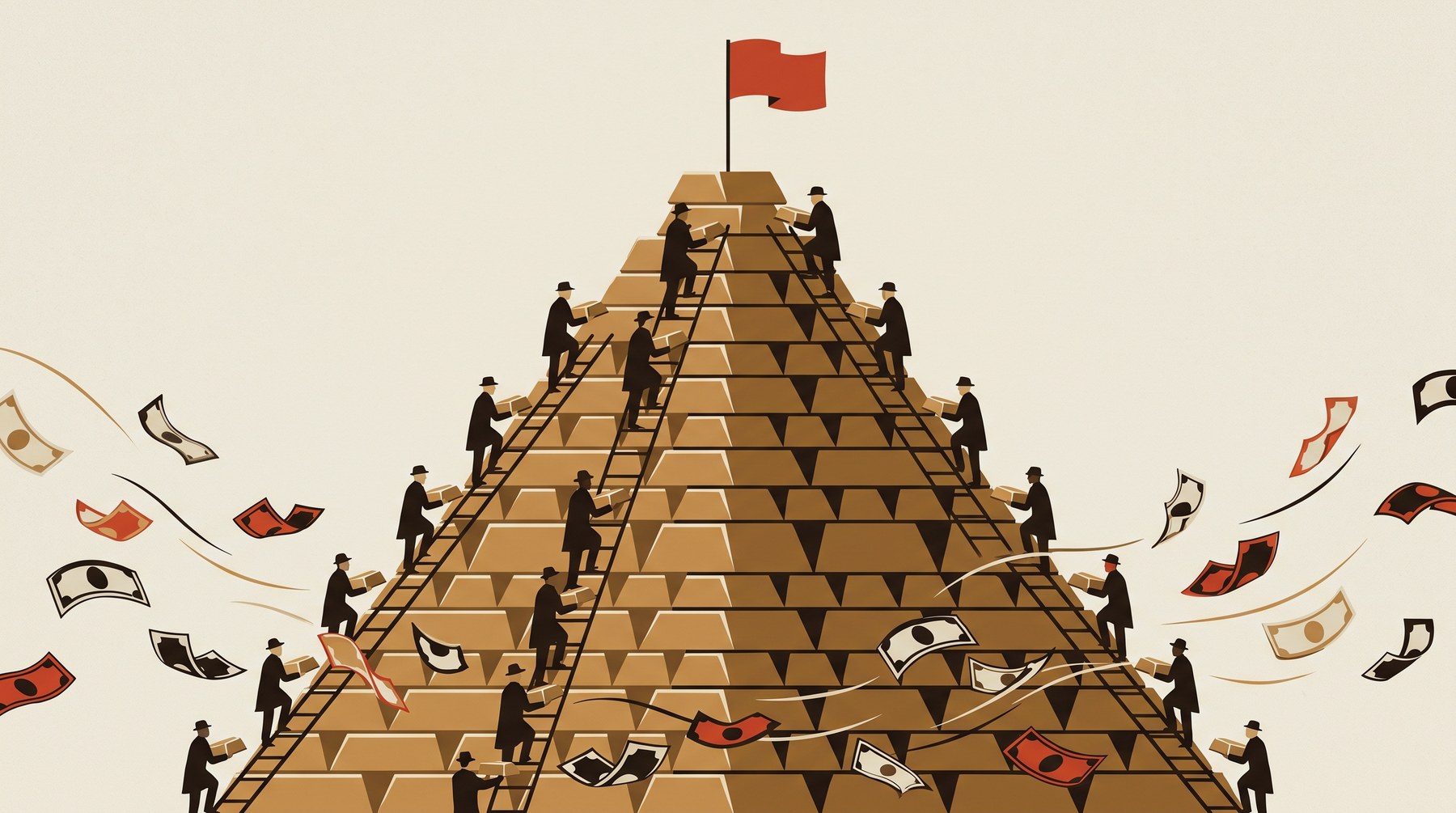
Keynes called the gold standard a barbarous relic in 1923, and the phrase stuck to the metal itself, which was unfair but convenient. Nixon cut the dollar's last tie to gold in 1971 with a televised shrug. Economists spent the following half century explaining, correctly, that gold pays no interest, earns nothing, does nothing, and costs money to guard. The case was airtight. The metal quadrupled anyway, and then, in the mid-2020s, made new all-time highs with the enthusiasm of a startup. The most interesting detail was the buyer. This was not a retail mania; the bid, year after year, came from central banks, the institutions whose entire product competes with gold.
The timing is not mysterious. In February 2022, in response to the invasion of Ukraine, western governments froze the reserves of the Russian central bank: roughly three hundred billion dollars of another sovereign's savings, switched off over a weekend by legal notice. Whatever one thinks of the cause, every finance ministry on earth received the same memo that morning. A reserve held in someone else's currency, in someone else's banking system, is a promise that the someone can revoke. Central bank gold purchases, already firm, roughly doubled in the years that followed, led by exactly the countries that could imagine reading such a notice themselves. Gold in a vault at home answers to no memo. It is the one reserve asset that has no issuer, which for four thousand years has been either its defect or its entire point, depending on the decade.
When the printers of money accumulate the thing that cannot be printed, a careful reader sits up.
Crypto discovered in 2022 that its rails could be sanctioned; Moscow discovered the same about the dollar system; both discoveries sent buyers toward assets that exist outside anyone's promise. Bitcoin was marketed for fifteen years as digital gold, and the marketing was better than its authors knew, though the resemblance is not the one on the brochure. The two assets share no technology and no constituency. What they share is a negative property: neither is anyone's liability. Everything else in a portfolio, every bond, deposit, stablecoin and share, is a claim on some counterparty's future behavior. Gold and its digital imitator are claims on nothing, which means there is nobody to disappoint you.
An asset with no cash flows cannot be valued, only priced, and its price is a referendum. On what, exactly? Nothing about gold is monocausal: real yields pull at it, the dollar pulls at it, fashion pulls at it, and any honest model leaves a remainder unexplained. But across the long arcs one variable keeps its grip. Gold's real price has tended to sag when the world believes its institutions, its treaties and its ledgers, and to rise when that belief thins. Inflation, despite the brochures, fits the record far worse; the metal slept through inflationary years and sprinted through quiet ones. The referendum of the mid-2020s, in which the yes votes were cast by central banks themselves, is worth reading slowly. The managers of the promise system are quietly buying the exit.
None of this makes the metal a sensible core holding for a person saving for retirement, and this magazine is not about to recommend one. Over any long stretch, productive assets, businesses that compound earnings, have buried it, and will likely go on burying it. Gold's owner earns no yield, pays for storage, and holds an asset whose entire return depends on someone later feeling worse about the world than the owner does today. As an investment it is mediocre. As an instrument panel it is superb. It is the needle that moves when the passengers with access to the cockpit start strapping on parachutes.
So the useful habit has less to do with owning gold than watching its owners. When the marginal buyer is a frightened saver in a collapsing currency, the metal is doing its oldest job, and the story is local. When the marginal buyer is the official sector of the world's rising powers, patiently, at any price, for years, the story is about the architecture: a slow vote against the assumption that the ledgers of the last century's winners are permanently safe places to keep the wealth of this one's. That vote can be wrong; the buyers of the relic have been early before, sometimes by decades. But their bid is information, and it costs nothing to read. Four thousand years into its career, the barbarous relic still performs its one service. It keeps a rough, running score of how far the world's institutions are trusted by the people who run them, and the score, unlike the commentary, is settled in metal.