Liquidity Is Invisible Until It Isn't
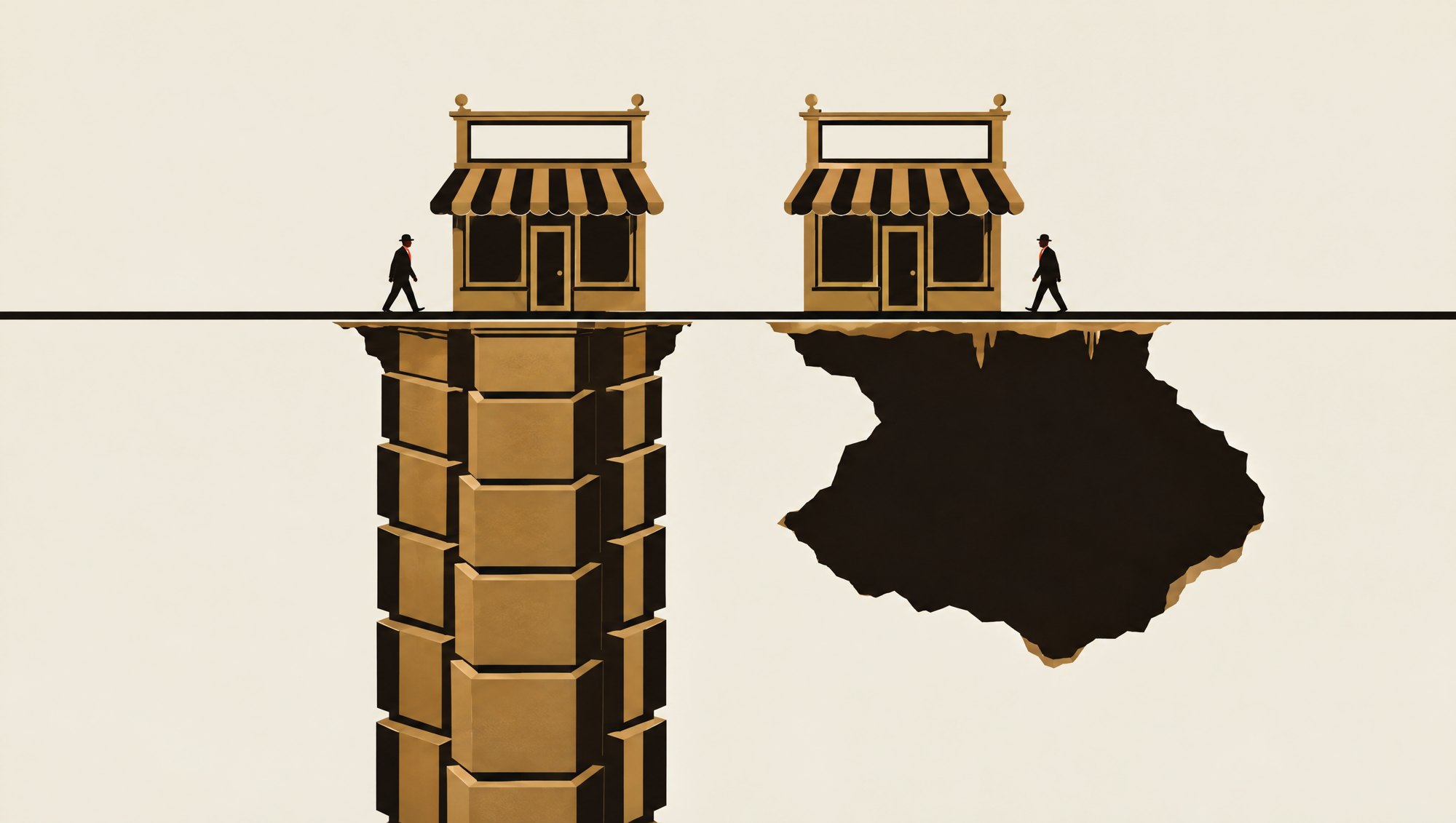
Two screens show the same price. One market can absorb a large order without flinching. The other would move several per cent. Nothing on either screen tells you which is which.
That is the difficulty with liquidity. It is the most important property of a market for anybody who trades size, and it has no ticker symbol. It lives below the displayed quote, in how much is offered at each price behind the best one, how quickly those offers come back after they are taken, and how many of them are real. Most of the time it is invisible because it is plentiful. It becomes visible at the moment it disappears.
Same price, different market
Our own capture contains a clean example, one second apart on the same venue. At 537 milliseconds into our second, Binance's best offer for bitcoin was $75,844.01. At 1,597 milliseconds, just after the second ended, it was $75,840.34. The two prices are $3.67 apart, half a basis point, close enough that nobody glancing at a screen would notice any change.
The markets underneath were not close. At +537 ms the twenty visible levels on the sell side held $30,094. At +1,597 ms they held $638,838, about 21 times as much.
Send the same order into both. A $25,000 purchase against the first book would have used 14 of the twenty levels and paid 0.11 bp over the screen. Against the second book it would have filled at the best offer. A $250,000 purchase could not have been priced at all from the first book, and would have cost next to nothing against the second. Same price. Different market.
Where it went
The thin book had a cause. It sat in the middle of a burst of buying that ran across all five venues, after the large order on page 44. Market makers who had been offering size either sold it or moved away. Within about a second they were back, at slightly higher prices, deeper than before. On a calm day that cycle happens constantly and nobody sees it, because the price barely moves.
Spreads tell a similar story. At the start of the second, the gap between best bid and best ask was a cent on Binance and Coinbase and ten cents on Bybit, Gate and OKX. By the end of the second the gap on Coinbase was $9.37 and on Gate $3.60. On the other three it had not moved. Nobody announced it. On two venues the people willing to act stepped back, and the price stayed on the screen as though nothing had happened.

When it goes all at once
Those were small, ordinary withdrawals, repaired within a second. Larger ones are the moments market history remembers. On 6 May 2010 US equity markets fell and recovered within about half an hour, and some shares traded at a cent or at $100,000 as market makers' placeholder quotes, known as stub quotes, suddenly became the only orders left in the book. On 15 January 2015, when the Swiss National Bank stopped holding the franc below 1.20 per euro, liquidity in one of the world's most traded currency pairs vanished for minutes and prices gapped by double digits in percentage terms.
In each case the displayed price before the event said nothing about what was about to happen, because a displayed price describes the best offer and says nothing about the ones behind it. Depth that has been there every day for years promises nothing. The orders that make it up are free to cancel, and they cancel together, because the people who place them are reacting to the same information at the same time.
Why the makers leave together
It is tempting to see the withdrawal of market makers in a fast market as desertion. From the inside it looks like arithmetic. A market maker earns the spread on trades with people who have no special information, and loses on trades with people who know something she does not. In calm markets the first kind dominates. When prices start moving fast, a larger share of the orders arriving are from people reacting to news she has not yet seen. Every quote she leaves in the book becomes an option she has given away for free.
So she widens her spread, reduces her size, or leaves. So does every other maker running a similar model on similar data, at the same moment. No single maker ever promised the liquidity that had been there for years. It was the sum of many separate decisions to stay, and the same signal reverses all of them.
That is also why it comes back. The first makers to return to a thin book are paid well, in wide spreads, for taking the risk. Within our frozen second, the Binance book went from thin to deeper than it had started in about one second. On the days market history remembers, the same process took minutes, and in a few cases exchanges had to stop trading to give it time.
Reading what cannot be seen
Professional traders therefore watch things the price does not show: how much is offered within a few basis points of the best price, how that changes through the day, how quickly the book refills after it is hit, how wide spreads are relative to their normal range. None of them is a forecast. Each is a way of asking the market how much weight its current price could bear.
They also know that the most dangerous moment is not a thin book but a thick one that nobody has tested. Page 42 shows Binance's visible sell side over the minute around our second. Three seconds before it, more than a million and a half dollars was on offer. Inside the second, thirty thousand. Nothing about the displayed price warned of either number.
Same number, one second apart. Behind the second one stood many times the money, and the screen never said a word about it.