The number at the top of this page was on our screen at 07:24:04 on 16 September, in the same second this whole issue is built on. It was Kraken's best bid for bitcoin, as our collector recorded it: $76,007.30, for 0.0537 bitcoin.
It was $256 above Kraken's own best offer at the same moment, which is impossible in a working order book: a buyer willing to pay more than a seller is asking would simply have traded with them. The level had last traded 18 minutes earlier, at 07:06:00. It stayed at the top of our record of Kraken's book, unchanged, for 56 minutes.
The venue had not made a mistake. We had. Our collector subscribed to the top ten levels of Kraken's book. When a level moved out of that window, Kraken simply stopped sending updates about it, and our code, which only removed levels when told their size was zero, kept it forever. We found the bug while preparing this issue, fixed it the same day, and withheld Kraken from every table in the issue. But the ghost bid is a perfect specimen for this article, because it looked exactly like a price.
Is it still a price?
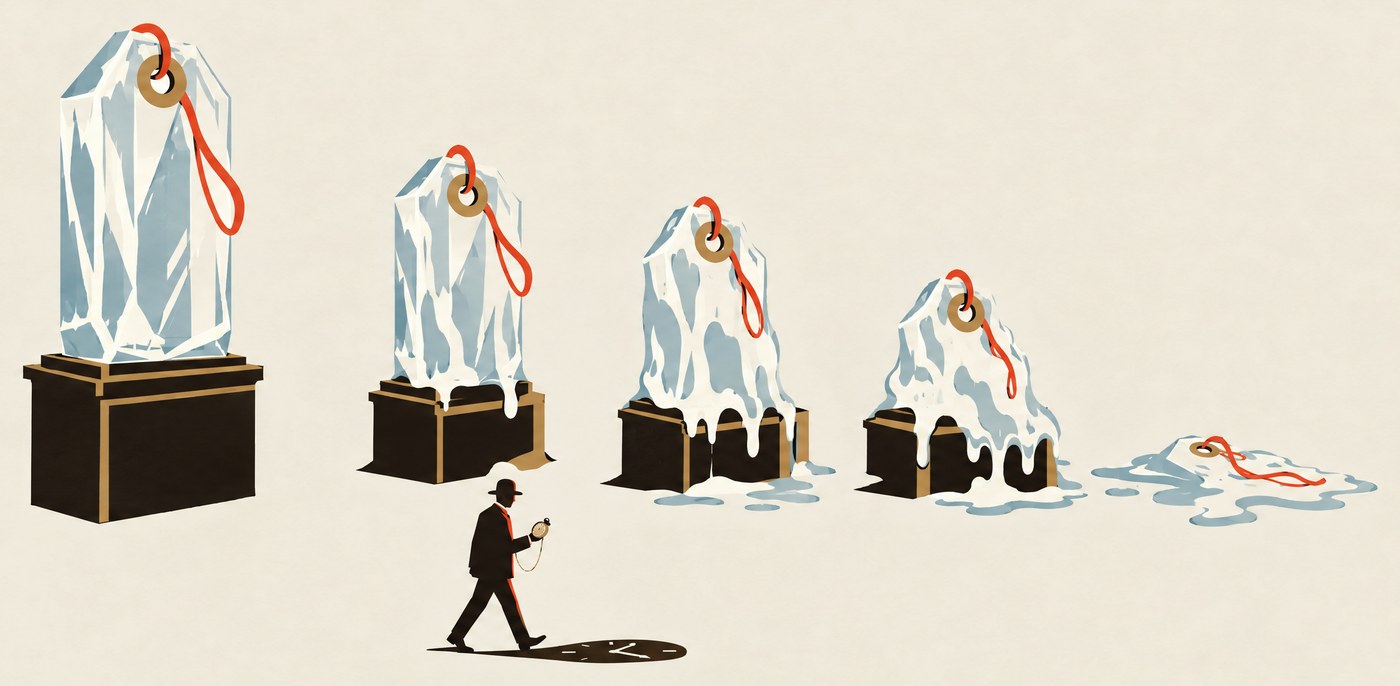
Every displayed price is a statement about the past. For a liquid market the past is milliseconds old and the statement is nearly true of the present. As the age grows, the same number means less. It does not become wrong all at once. It decays.
A last trade from a second ago tells you roughly where you could trade now. From an hour ago, it tells you where the market was. From a month ago, it tells you what somebody once paid. From five years ago, on an instrument that has not traded since, it tells you almost nothing about value and a good deal about history.
Screens rarely say so. Most displays show a number without its age, in the same type and colour whether it is fresh or years old.
How prices go stale
Trading halts are the everyday case. An exchange stops trading in a share pending news, and the last price sits on every screen until trading resumes. It may resume far away. Circuit breakers do the same across whole markets for minutes.
| Trade | Tells you where you could trade now, at that size |
| Seconds | Close to executable on a liquid venue; our frozen second lives here |
| Minutes | Where the market was; our ghost Kraken bid, 18 minutes stale |
| Days | Halted shares, closed markets: Moscow, 28 Feb to 24 Mar 2022 |
| Months | Private assets, delisted instruments, tokens whose venues have closed |
Closed markets are the larger case. After Russia invaded Ukraine in February 2022, the Moscow Exchange kept its stock market shut from 28 February until 24 March, and the London Stock Exchange suspended trading in the depositary receipts of many Russian companies in early March. For weeks their last prices remained on screens and in index calculations and fund valuations, describing a market that did not exist in any form an investor could use.
Delisting leaves a last price permanently. A company taken private, a fund wound up, a token whose venues have closed: each has a final print that will stay in databases forever, perfectly accurate as history.
Private assets live permanently in this condition. A private equity fund reports the value of companies that have not traded, usually quarterly and with a lag, based on appraisals, comparable listed companies and recent funding rounds. Its reported value can stay calm through a market fall that would have repriced the same companies on an exchange within days.
The quiet version
Most stale prices are not dramatic. A bond that trades a few times a month is marked every day by a pricing service using quotes and models. A property fund values its buildings every quarter. A small company's shares trade a few hundred times a day, and its last price at the close may be from a trade of a few shares an hour earlier. Each of these numbers is reasonable. Each is also, quietly, a statement about some time ago, set in the present tense.

The danger lies in combining them. A portfolio that holds a liquid index fund and an illiquid private fund shows a total that adds a price from this minute to a price from last quarter. In a falling market the total looks steadier than anything inside it really is.
What to ask of any number
The defence is simple and almost never used. For any price, ask how old it is. Ask when the instrument last traded, and in what size. Ask whether the market it came from is open. Ask whether the source is still sending updates, or whether a number is merely still there, which, as our own collector demonstrated, can look identical.
Our ghost bid was a real number, correctly stored, faithfully displayed. It had simply stopped being a price 56 minutes before we noticed, and nothing on the screen said so.