Who Owns the Number?
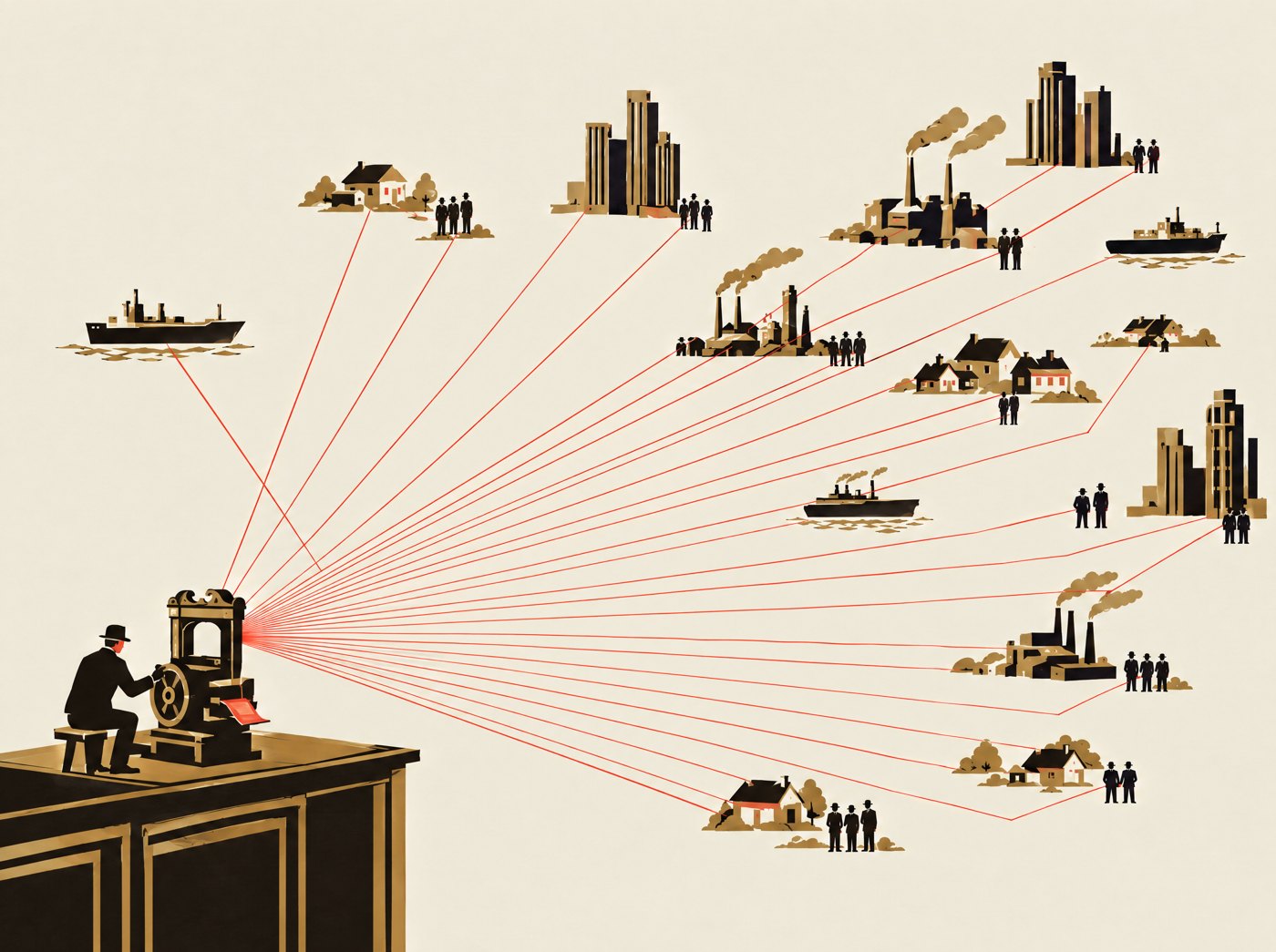
If prices can be constructed, somebody writes the construction rules. For most of the numbers that matter, that somebody is a small organisation almost nobody outside finance has heard of, working from a methodology document almost nobody has read.
Modern finance runs on reference numbers. A mortgage resets against a rate. A pension fund owns a slice of an index and is judged against it. A mine sells its gold at a benchmark. A futures contract settles against a reference rate. A lending protocol on a blockchain liquidates a borrower when an oracle says the collateral has fallen far enough. None of these contracts names a trade. Each names a number, and a procedure for producing it.
Once a number decides who pays whom, the procedure stops being a technicality. Somebody specifies the inputs. Somebody specifies the rule. Somebody runs it and publishes. Every one of those roles creates an incentive, and every incentive a failure mode. Governance, the unglamorous business of who is allowed to do what and who checks, becomes a piece of market infrastructure as real as a matching engine.
The rate that was asked, not traded
LIBOR, the London Interbank Offered Rate, is the case everybody learns, for good reason. From 1986 it was published under the British Bankers' Association, and for decades it sat underneath an enormous range of contracts: interest rate swaps, syndicated loans, floating-rate notes, student loans and American adjustable-rate mortgages. The US regulators' own working group estimated in 2018 that around two hundred trillion dollars of financial contracts referenced US dollar LIBOR.
Nothing ever traded at LIBOR. Each morning a panel of banks was asked, in effect, a hypothetical question: at what rate could you borrow funds, were you to do so by asking for and then accepting interbank offers in a reasonable market size just before 11 am London time? Each bank submitted a number. The highest and lowest quarter of submissions were thrown away, the middle was averaged, and the result was published for each currency and each borrowing period.
The design had a logic. Banks did lend to each other unsecured, but not in every currency and every maturity every day, so a survey of informed estimates could cover gaps that transactions could not. Trimming the extremes meant one strange answer could not move the result much.
The design also had two flaws that nobody had to be a villain to exploit. The submissions were judgements, so they could not be proved wrong. And the banks submitting them held positions whose value depended on the answer.
What went wrong
Two kinds of pressure turned out to act on the number. In 2007 and 2008, a bank that submitted a high borrowing rate was telling the world it was in trouble. Some banks submitted lower rates than they could really borrow at, protecting their reputations at the moment it mattered most. Separately, and for years, derivatives traders at some banks asked the colleagues who made the submissions to nudge them up or down a little on days it suited their positions, and in some cases coordinated with traders at other banks.
In June 2012 Barclays settled with British and American authorities for a combined sum of around £290 million, and the internal messages published alongside made the mechanics painfully concrete. Other banks followed with far larger settlements. The UK's Wheatley Review recommended in September 2012 that submitting to and administering LIBOR become regulated activities. ICE Benchmark Administration took over as administrator in February 2014, and submissions were anchored to transactions wherever they existed.
 LIBORSOFRGoldCloseS&P 500BRROracle
| Output | Input | Rule | Administrator | Dependencies |
|---|---|---|---|---|
| LIBOR (USD) | Bank submissions to a hypothetical question | Trim top and bottom quarter, average the rest | BBA, then ICE Benchmark Administration | ~$200tn of contracts (2018 est.) |
| SOFR | Overnight Treasury repo transactions | Volume-weighted median | Federal Reserve Bank of New York | Loans, swaps, futures |
| LBMA Gold Price | Bids and offers from auction participants | Electronic auction until balanced, 10:30 and 15:00 | ICE Benchmark Administration | Mine contracts, fund NAVs |
| Closing price | Orders sent to the closing auction | Single price maximising matched volume | The listing exchange | Fund valuations, index levels |
| S&P 500 | Eligible US companies | Committee selection, float-weighted | S&P Dow Jones Indices | Index funds, futures, options |
| CME CF BRR | Trades on constituent crypto exchanges | 12 five-minute medians, averaged | CF Benchmarks | CME bitcoin futures settlement |
| On-chain oracle | Off-chain venue prices | Code-defined filters and aggregation | Oracle operator or network | Loans, liquidations |
A contributor at each panel bank considers the question for each currency and maturity: at what rate could this bank borrow, by asking for and accepting interbank offers in reasonable size?
Submissions go to the calculation agent. No transaction has to back them.
For each rate, the highest and lowest quarter are discarded. The remaining submissions are averaged with equal weight.
Rates are published to data vendors and flow into contracts, loan resets and valuation systems worldwide.
A submission is an opinion, so it cannot be shown false. Submitters sit in banks whose positions gain or lose with the number.
Low-balling to look healthy in the crisis; traders asking for nudges on days it suited them. Barclays settles in June 2012.
ICE Benchmark Administration takes over, submissions anchored to transactions. The USD panel ends on 30 June 2023.
It was not enough to save the number. The unsecured interbank lending LIBOR was supposed to describe had shrunk to the point where most submissions could not be tied to real trades. Regulators pushed markets to move to rates built from transactions. The US dollar LIBOR panel ended on 30 June 2023.
What replaced it, and what it solves
The replacement for dollar LIBOR is SOFR, the Secured Overnight Financing Rate, published by the Federal Reserve Bank of New York since April 2018. Transactions go in, not answers: the rate on overnight loans secured by US Treasury securities in the repo market, taken as a volume-weighted median across trades that in 2026 have run to roughly three trillion dollars a day.
It solves the problem LIBOR died of. A median of that many real transactions is very hard to push, and nobody has to guess. It also changed what the number describes. SOFR is overnight and secured against government bonds, so it contains almost no bank credit risk. LIBOR, whatever its faults, tried to describe what it cost a bank to borrow unsecured for months. Every benchmark reports a market, and first it picks which one.
Gold went through its own reform. For almost a century the London gold price was fixed by a small group of banks on a call, in a process dating from 1919. In May 2014 the UK regulator fined Barclays £26 million after a trader manipulated the fix on one day to avoid paying a client. From 20 March 2015 the fix was replaced by the LBMA Gold Price, an electronic auction administered by ICE Benchmark Administration, run twice a day at 10:30 am and 3 pm London time, with bids and offers from direct participants and an audit trail.

Judgement never leaves
Transactions are not the only answer, and in some places they are not an answer at all. The most famous stock index in the world, the S&P 500, is not a list of the five hundred largest American companies chosen by formula. Its members are selected by a committee at S&P Dow Jones Indices, applying published eligibility criteria and its own discretion. Trillions of dollars in index funds buy whatever that committee adds.
Closing prices, the numbers that value most funds each evening, are increasingly set in a closing auction, a single matching at the end of the day into which a large share of index-fund trading is deliberately concentrated. The rules of that auction, how imbalances are published and when orders may be cancelled, decide the number that becomes the day's official price.
What a good benchmark looks like
After LIBOR, regulators wrote down what they had learned. In July 2013 IOSCO, the international body of securities regulators, published principles for financial benchmarks, and the European Union later turned similar ideas into law in its Benchmarks Regulation. The principles are unglamorous and precise, and they read like a list of everything that went wrong.
A benchmark should be anchored in observable transactions wherever possible. Its methodology should be published, and changes to it consulted on. The administrator should manage conflicts of interest, keep records, and be subject to oversight by somebody independent of the people who make submissions. When data is thin, the benchmark should say so and explain what it does instead. And it should be designed with the possibility of its own end in mind, so that contracts which depend on it can find a replacement.
None of that guarantees a good number. It moves the question from whether the people making a number are honest to whether the process makes dishonesty difficult and visible, which is the only question a user of a benchmark can actually check.
The same problem, in new architecture
Blockchains reproduce all of this in software. A lending protocol has no way to see a price by itself. It must be told by an oracle, a system that reads venues off-chain, applies filters and weights, and writes a number on-chain that contracts then treat as fact. The oracle is an administrator, its code is a methodology, and its sources are a panel.
The failure modes are recognisable. In October 2022 a trader bought up the thinly traded token of the Mango Markets protocol on the venues its oracle read, watched the reported price multiply, and borrowed against the inflated value, leaving with roughly $110 million. He was later convicted of fraud; in 2025 a federal judge set the convictions aside. Whatever the law finally says about the trader, the oracle did what it was designed to do. It reported the price the market showed. The market it chose to read was small enough to own for a few minutes.
That is the thread through every case in this article. Nobody owns a number outright. But somebody always decides which market it listens to, and what it ignores, and whether the people who can move it are also paid by it. Reading those rules sounds like homework for specialists. It is also the only way to know what a number is actually telling you.
For nearly four decades somebody asked a question at 11 am every London morning, and the answers set the price of an enormous amount of money. Whenever a number matters, find out who is asking now.