The Price That Never Traded
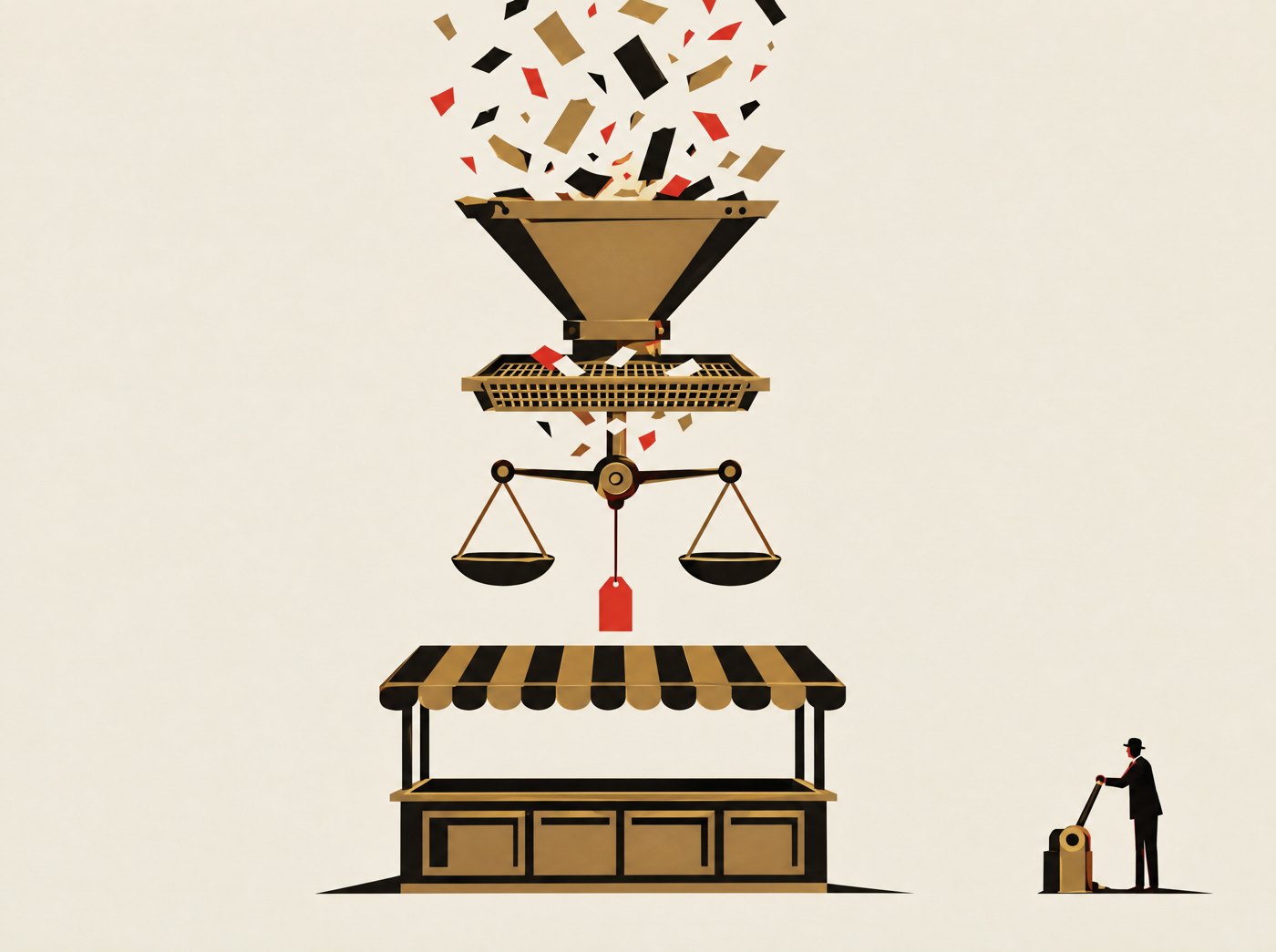
There are prices at which nobody bought anything. They are not rare, and they are not errors. Some of the most important numbers in finance are of this kind, and most people who rely on them have never noticed.
An index level is one. So is the mark price an exchange uses to decide whether your futures position has run out of margin. So is the net asset value of a fund, struck once a day from somebody else's prices. So is a volume-weighted average price, the benchmark a broker is judged against, and a fair value an auditor signs off for an asset that has not traded in months. Each is computed. None needs a buyer and a seller to have met at that figure.
Here is one from our second. Take every print on the four tether venues between 07:24:04.000 and .999, weight each by its size, and average. The answer is $75,822.48. It is a perfectly reasonable description of where bitcoin changed hands in that second, and it is the kind of number an execution desk would be measured against. Of the 651 prints that produced it, none crossed at that price. 8 came within fifty cents of it.
No paradox there: the average of 3 and 5 is 4, and nobody had to hold a four. It does raise the question this article is about, though. Can a price be real if nobody ever paid it?
Why a trade is not enough
The obvious answer is that the last trade is the only honest price, and everything else is modelling. Our own second shows why nobody who runs a market believes that.
Remember the quarter-cent trade from page 13. Had it crossed a few dollars away from everything else, it would have been the last trade for a moment. If futures positions were settled against the last trade, a quarter-cent transaction on a thin venue could decide whether somebody else's position worth millions was liquidated. That is exactly the attack mark prices are built to resist.
So a derivatives exchange does not mark to its own last trade. It builds a mark from an index of spot venues, usually several, usually with outliers discarded and stale sources dropped, and then smooths it. The mark is designed to be harder to push around than any single print. It is a price at which nobody traded, deliberately, because a traded price was too easy to fake.
A fund faces a different version of the same problem. Its investors need one number a day to buy and sell units at. The assets inside it trade at different times, in different places, and some hardly at all. The fund's administrator takes a set of chosen reference prices at a chosen moment, applies them, subtracts fees, divides by units outstanding, and publishes. SPDR Gold Shares, the largest gold fund, values its metal once a day at the LBMA Gold Price set in the afternoon auction in London. The fund's NAV is a price nobody paid, built on a benchmark that, as page 29 describes, is itself a small machine.

Sources, filters, weights, output
Every constructed price, from an index to an oracle feeding a lending protocol, is built the same way. Somebody chooses sources. Somebody writes filters that decide which observations to throw away: too old, too far from the others, too small, from a venue that has stopped answering. Somebody chooses weights. A calculation runs, and a number comes out with a timestamp on it.
Each of those choices is a judgement, and each can be defended. A median ignores one crazy venue; a mean does not. A volume weighting follows where the money is; it also follows where wash trading is. A tight staleness filter protects against frozen feeds and throws away honest quiet ones. The choices are published for the benchmarks that matter most, and it is worth reading them, because they are the difference between two numbers that both claim to be the price of the same thing.
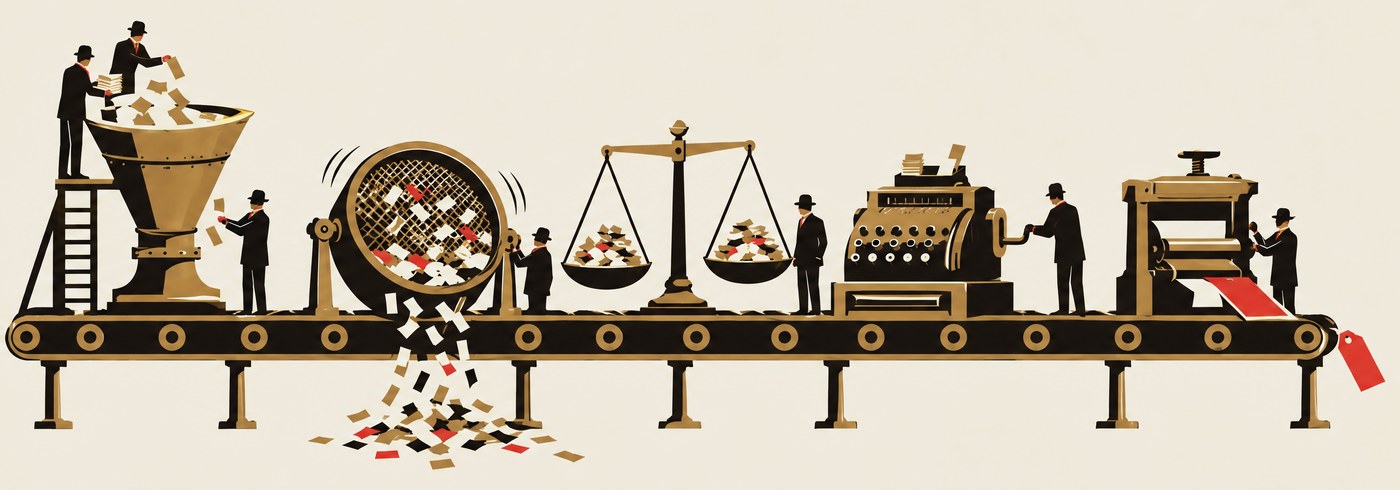 SourcesFiltersWeightsCalculationOutput
| Price | Sources | Rule | What it decides |
|---|---|---|---|
| Index | several venues | median or weighted mean | a level |
| Mark price | an index of spot venues | smoothed, outliers removed | margin and liquidation |
| NAV | reference prices at a set time | holdings minus fees over units | fund dealing price |
| VWAP | every trade in a window | weighted by size | execution benchmark |
| Fair value | comparables and models | a person signs it | a balance sheet |
- Lastthe price of the most recent trade, of any size
- Bid / askthe best standing offers to buy and to sell
- Midhalfway between them; nobody can trade there on a one-tick spread
- Markan exchange's own settlement price for margin, built to resist single trades
- Indexseveral venues combined by a published rule
- VWAP / TWAPaverage trade price weighted by size, or by time
- NAVa fund's holdings at reference prices, less fees, per unit
- Fair valuean accounting estimate where there is no active market
CF Benchmarks, which calculates the bitcoin reference rate CME futures settle against, is a useful example of how specific those rules get. Its daily rate takes trades from a set of constituent exchanges over one hour, splits the hour into twelve five-minute partitions, takes a volume-weighted median in each, and averages the twelve equally. No trade needs to have happened at the result. Several billion dollars of futures settle on it anyway.
Our own number
We should declare our interest here, because our own systems make constructed prices, and our capture of this second contains one.
One of our collectors records a reference price for bitcoin every ten seconds, for risk checks. For 07:24:04 it recorded $75,807.195. The source field reads binance-fallback: the oracle we would prefer was not the one used. The figure is the midpoint of Binance's best bid and ask at the start of the second, and it has half a cent in it. Binance quotes in whole cents, so no trade could ever have happened at that price. The row reached our database 1.227 seconds after the instant it described, by which time Binance's best offer was $75,844.01.
Nothing about that is broken. The row is labelled honestly: where the number came from, when it was published, how old it was on arrival, and whether it passed our checks. Often the most useful price has no transaction behind it at all, only a statement with its provenance attached, and it deserves exactly as much trust as that provenance is complete.
The accountants got there first
Accounting standards settled this argument long ago, and their answer is worth borrowing. Both the international and the American rules for fair value sort every measurement into three levels. Level 1 is a quoted price in an active market for an identical asset: a traded price, used as it stands. Level 2 uses observable inputs that are not quite that, such as quotes for similar assets or prices from markets that trade rarely. Level 3 uses inputs that cannot be observed at all, and relies on a model and the judgement of whoever runs it.
Every one of the three levels produces a number called fair value, and all of them end up on a balance sheet in the same column. The standards insist that the level is disclosed, precisely because the numbers look identical once printed. A reader of a bank's accounts who does not look at how much of its assets are valued at Level 3 is reading a list of prices without the one piece of information that says how much each deserves to be believed.
Market screens could learn from it. This issue borrows it for its own figures: observed, calculated, reported, argued. Attach the level and a number tells you how far to trust it. Leave it off and the number asks for trust it has not earned.
So is it real?
A constructed price is real in the only sense a price can be: people act on it. Positions are liquidated at marks, fund units are bought and sold at NAVs, trillions of dollars of loans have reset against benchmark rates. Nobody paid the number, but a great many people paid because of it.
What changes is where the risk sits. With a traded price, the question is whether the market was deep enough to mean anything. With a constructed price, the question is who chose the sources, who wrote the filters, and what they stood to gain from the answer. That second question has an unhappy history, and it is the subject of page 27.
Before that, one more thing a price is supposed to be unable to do.